


Last Updated: 11.11.2026
Working from home tax relief previously allowed eligible UK employees to reduce their Income Tax bills when they had to work from home and incurred additional household expenses.
However, HMRC removed this relief for employees’ unreimbursed homeworking costs from 6 April 2026.
Employees can still make backdated claims for the previous four tax years if they meet the earlier eligibility rules.
Employers can also continue providing qualifying tax-free homeworking payments, while self-employed individuals can claim eligible business expenses under separate rules.
Understanding these differences is important because the amount available, the claiming process and the supporting evidence all depend on your employment circumstances.
Who Qualifies for Working From Home Tax Relief From Previous Tax Years?
Employees who were required to work from home during an eligible earlier tax year may still qualify for tax relief on additional household expenses.
However, simply working remotely or having permission to work from home does not automatically make someone eligible.
Under the previous rules, HMRC generally required employees to demonstrate that working from home was necessary because of their job rather than a personal preference.
Eligibility Requirements for Employees
You may qualify for an earlier tax year if:
- Your Employer Had No Suitable Office: You were required to perform your duties from home because your employer did not provide an office.
- Your Job Required Homeworking: The nature or location of your employment made working from home necessary.
- You Paid Additional Household Expenses: You incurred qualifying work-related costs that your employer did not fully reimburse.
- You Have Supporting Evidence: You can demonstrate that homeworking was a requirement rather than a voluntary arrangement.
Employees who worked from home under the special COVID-19 arrangements should check the rules applicable to the particular tax year. The temporary pandemic concessions did not continue indefinitely.
The important distinction is between employees who had to work from home and employees who chose to do so.
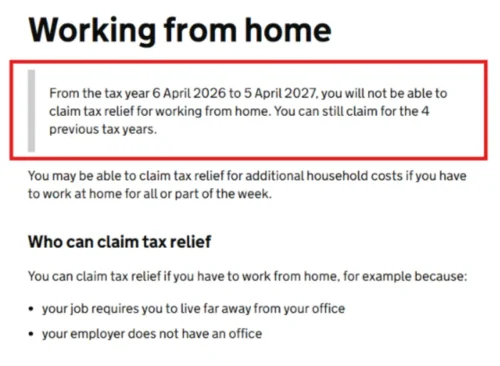
HMRC confirms the removal of working-from-home tax relief for current employee expenses and explains the availability of claims for previous tax years.
Can Hybrid Workers Claim Tax Relief?
Hybrid working involves dividing working hours between home and another workplace. Although this arrangement has become common, it does not automatically qualify an employee for tax relief.
If an employer maintains an available office and an employee chooses to work from home for convenience, the employee generally cannot claim the previous homeworking deduction.
Even where a contract permits remote working, that permission alone does not establish eligibility for an earlier tax year.
The continuing growth of remote working in British homes has changed how people organise their working lives, but HMRC’s historical eligibility conditions remained more restrictive than general flexible working policies.
For expenses incurred from 6 April 2026, the employee household-expense deduction is unavailable regardless of whether homeworking is voluntary or compulsory.
Nevertheless, qualifying employer-paid homeworking allowances remain available under separate tax rules.
How Much Working From Home Tax Relief Can You Claim?
For eligible previous tax years, employees could claim tax relief based on a flat-rate allowance of £6 per week or the actual additional household expenses incurred.
The flat-rate method was simpler because employees did not need to calculate the precise amount of additional household spending. However, supporting evidence that homeworking was required may still be necessary.
Tax Relief Rates and Potential Refund Amounts
The amount of tax relief depends on the employee’s applicable Income Tax rate.
For example, an eligible employee claiming the £6 weekly allowance for 52 qualifying weeks would have a total deductible expense of £312.
| Income Tax Rate | Weekly Tax Saving | Annual Tax Saving |
| 20% Basic Rate | £1.20 | £62.40 |
| 40% Higher Rate | £2.40 | £124.80 |
| 45% Additional Rate | £2.70 | £140.40 |
These figures assume 52 qualifying weeks, sufficient Income Tax liability and that the stated rate applies to the full deduction. Scottish Income Tax rates may produce different amounts.
Importantly, £312 represents the potential annual deduction, not the amount automatically refunded to an employee.
Employees who incurred higher qualifying expenses could instead claim the actual additional costs, provided they had appropriate supporting records.
Such expenses could include additional gas and electricity consumed while working and qualifying metered water usage. General household costs that would have arisen regardless of employment were not automatically deductible.
Previous Tax Year Claims and Deadlines
Although employees can no longer claim for new household expenses, HMRC continues to accept eligible claims for earlier tax years.
The standard deadlines are:
| Tax Year | Final Claim Deadline |
| 2022/23 | 5 April 2027 |
| 2023/24 | 5 April 2028 |
| 2024/25 | 5 April 2029 |
| 2025/26 | 5 April 2030 |
These deadlines reflect the usual four-year claiming limit following the end of each tax year. Individual circumstances and the appropriate Self Assessment or overpayment-relief procedures can affect how a claim must be submitted.
For example, somebody who qualified during 2022/23 but never claimed relief should generally submit the claim before 5 April 2027.
Employees should also check whether they have already received tax relief for the same expenses, as duplicate claims are not permitted.
How to Claim Working From Home Tax Relief From HMRC?
Employees seeking relief for previous tax years should use the official HMRC process and provide accurate details about their employment and expenses.
The method depends on whether the employee normally pays tax through PAYE or completes a Self Assessment tax return.
Step-by-Step Process for Backdated Claims
- Check Your Eligibility: Confirm that working from home was required during the relevant tax year and that your expenses were not fully reimbursed.
- Identify the Tax Year: Establish which previous tax years you are claiming for and whether they remain within the permitted deadline.
- Calculate Your Allowable Expenses: Decide whether the historic £6 weekly rate or qualifying actual expenses are appropriate.
- Gather Your Evidence: Collect documents showing that you were required to work from home, along with relevant bills if claiming actual costs.
- Visit the Official HMRC Service: Use GOV.UK’s working from home tax relief guidance to check eligibility and find the appropriate claiming route.
- Submit Your Claim: Follow HMRC’s instructions, which may involve the online service, a postal P87 claim or Self Assessment.
- Check Your Tax Repayment: Review HMRC’s decision and any resulting refund or tax calculation.
Employees who normally complete Self Assessment should claim through the appropriate tax return procedure rather than submitting a duplicate employment-expenses claim.
What Documents and Evidence Are Required?
HMRC requires evidence that homeworking was necessary for claims using the £6 weekly rate for 2022/23 onwards. Employees claiming actual costs must also provide evidence of the expenditure.
An employment contract showing compulsory homeworking may be sufficient, although other employer documentation can be relevant when the requirement is not expressly written into the contract.
For actual expenses, employees should retain bills, receipts and calculations demonstrating the additional work-related costs.
Under the relevant historic rules, voluntary homeworking does not become eligible simply because someone has utility bills or regularly uses a room as an office.
Once HMRC approves a valid previous-year claim, the repayment may be issued through the applicable tax repayment process.
Employees who believe they have overpaid Income Tax can also check the wider rules surrounding unclaimed PAYE tax refunds.
The exact repayment method depends on HMRC’s assessment and the employee’s tax circumstances.
What Working From Home Expenses Are Still Tax-Free?
The abolition of direct employee homeworking deductions does not mean every form of homeworking financial support has disappeared.
Employers can still cover certain additional household costs without deducting Income Tax or National Insurance, provided the payments satisfy HMRC’s conditions.
The £6 Weekly Tax-Free Employer Allowance
Employers can make qualifying tax-free payments towards additional household expenses where employees regularly work from home under agreed homeworking arrangements.
The current standard limits are:
| Payment Frequency | Tax-Free Limit |
| Weekly | £6 |
| Monthly | £26 |
| Annual Equivalent | £312 |
The annual equivalent assumes 52 weekly payments or 12 monthly payments.
These payments are different from employees independently claiming tax relief.
An employee receiving £6 per week from an employer receives the payment itself, whereas the former HMRC deduction generally provided a tax saving calculated on £6.
Employers may reimburse qualifying additional expenses exceeding these limits, but they must be able to substantiate the amounts.
The £6 weekly payment is not an automatic employee entitlement. Employers must choose to provide it, and the necessary homeworking conditions must be met.
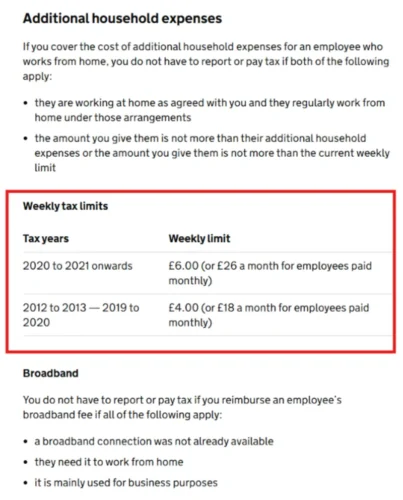
HMRC lists the £6 weekly and £26 monthly tax-free limits for qualifying employer payments towards additional homeworking household expenses.
Household Bills and Home Office Equipment
Qualifying employer payments may cover additional household expenses such as electricity and heating costs directly associated with working from home.
However, ordinary personal expenses cannot automatically be treated as tax-free employment costs.
Broadband costs require particular care. For example, where an employee already has an internet connection for personal use, reimbursing the ordinary subscription is not automatically exempt.
Different treatment may apply where a new connection is needed mainly for work.
Equipment also has separate rules.
Employers can generally provide qualifying equipment such as laptops, computers and necessary office supplies without creating a taxable benefit when the required business-use conditions are satisfied.
From April 2026, the tax treatment of qualifying employer reimbursements was expanded to include certain equipment purchased by employees for their employment duties.
This means employers may reimburse eligible homeworking equipment without triggering Income Tax or National Insurance when the exemption requirements are met.
Employees should therefore check their employer’s expenses policy before purchasing expensive homeworking equipment personally.
Can Self-Employed Workers Still Claim Working From Home Expenses?
Self-employed individuals operate under different rules from employees.
The removal of the employee household-expense deduction does not prevent qualifying sole traders from claiming legitimate business-use homeworking costs when calculating taxable trading profits.
Self-employed workers generally have two ways to calculate their homeworking expenses: HMRC’s simplified expenses method or an appropriate proportion of actual household costs.
Simplified Expenses vs Actual Household Costs
HMRC’s simplified expenses method allows eligible sole traders to claim a fixed monthly amount according to the number of hours they work from home.
| Monthly Hours Worked From Home | Allowable Flat Rate |
| 25–50 Hours | £10 |
| 51–100 Hours | £18 |
| 101 Hours or More | £26 |
For example, a self-employed consultant working from home for 120 hours each month could potentially claim £26 per month, equivalent to £312 across 12 qualifying months.
These figures are allowable expense deductions, not direct tax refunds.
The simplified method does not include business telephone and internet costs, which can be calculated separately using an appropriate business-use proportion.
Alternatively, self-employed individuals may calculate the allowable business proportion of eligible expenses such as heating, electricity, rent and mortgage interest.
The calculation should reasonably reflect how much of the home is used for business purposes and for how long. Mortgage capital repayments and private expenses are not deductible as ordinary business costs.
Choosing between the simplified method and actual-cost calculations can make a difference to the overall use of home as office allowance, particularly for businesses with substantial household running costs.
The 25-hour monthly threshold only applies to the simplified-expenses method. Someone working fewer hours may still qualify to deduct an appropriate share of actual allowable costs.
Self-employed individuals should maintain reliable records and include qualifying expenses in their tax calculations.
Reviewing these costs alongside other end-of-year tax considerations for the self-employed can help avoid overlooking legitimate deductions.
Company directors should distinguish between expenses paid personally, employer reimbursements and company-provided equipment, as their tax treatment may differ from that of sole traders.
Conclusion
Working from home tax relief has changed significantly, but financial support remains available in certain circumstances.
Employees can no longer claim HMRC tax relief for new unreimbursed household expenses, although eligible backdated claims remain possible for the previous four tax years.
Employers can still offer qualifying tax-free allowances and reimbursements, while self-employed individuals may continue deducting legitimate business-use household expenses.
The most important step is to identify whether you are an employee, a company director or self-employed, then follow the appropriate HMRC rules for your circumstances.
Checking previous-year eligibility, keeping accurate records and reviewing employer reimbursement policies can help ensure that you claim available relief without relying on outdated guidance.
The tax rules, claim evidence requirements, employer exemptions and self-employed flat rates in this article were checked against current HMRC guidance.
Frequently Asked Questions
Can I Claim Working From Home Tax Relief in 2027?
Employees cannot claim the abolished deduction for household expenses incurred in 2026/27. However, eligible previous-year claims can still be submitted within the applicable deadlines.
How Far Back Can I Claim Working From Home Tax Relief?
HMRC normally allows eligible claims for the previous four tax years. The earliest tax year generally available in November 2026 is 2022/23.
How Much Tax Can I Get Back for Working From Home?
Under the previous £6 weekly allowance, a 20% taxpayer could save £62.40 for 52 qualifying weeks, while a 40% taxpayer could save £124.80.
Can I Claim Tax Relief If I Work From Home Two Days a Week?
For earlier years, working two days at home did not automatically qualify you. Eligibility depended on whether homeworking was necessary rather than voluntary and on the rules for that tax year.
Can My Employer Still Pay Me £6 Per Week Tax-Free?
Yes. Employers can continue making qualifying tax-free homeworking payments of up to £6 weekly or £26 monthly under HMRC’s employer reimbursement rules.
Do I Need Receipts to Claim Working From Home Tax Relief?
For eligible claims using the £6 rate for 2022/23 onwards, HMRC requires evidence that you had to work from home. Actual-expense claims also need supporting bills or receipts.
Can Company Directors Claim Working From Home Expenses?
Directors cannot use the abolished employee household-expense deduction for new costs, but their companies may provide qualifying homeworking reimbursements or equipment under the relevant tax rules.