

Last Updated – 03-11-2026
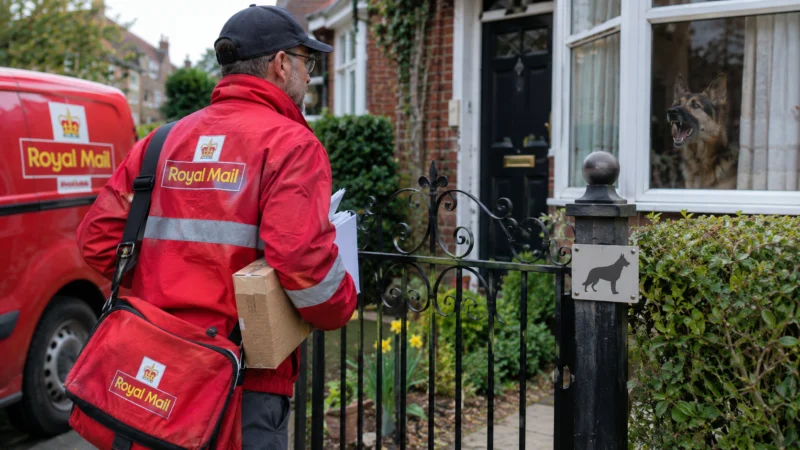
Royal Mail is encouraging dog owners across the UK to display a simple four-word warning sign outside their homes to help protect postal workers from dog attacks.
The message, “I HAVE A DOG”, alerts postmen, postwomen and delivery drivers that an animal is present and asks them to wait while the homeowner secures their pet before opening the door.
With Christmas 2026 approaching and parcel deliveries expected to increase, the advice is particularly relevant to households receiving regular online orders.
According to Royal Mail’s latest figures, 2,019 dog attacks were reported against postal workers during 2025/26, equivalent to approximately 38 incidents every week.
Although attacks decreased by 8% compared with the previous year, the company continues to highlight the risks associated with unsecured dogs.
Importantly, displaying the warning sign is voluntary. However, failing to control a dog could result in delivery suspension, legal consequences and serious injuries.
What Is the Royal Mail Dog Warning Sign?
The Royal Mail dog warning sign is a printable notice designed to inform postal workers that a dog lives at a property.
The official notice starts with four words:
“I HAVE A DOG”
It then includes an instruction requesting that the delivery worker wait while the homeowner secures the animal.
Unlike traditional signs stating “Beware of the Dog”, Royal Mail’s version focuses on preventing unsafe encounters rather than suggesting the animal is aggressive.
Its purpose is to establish a safer delivery process by allowing owners to secure their dogs before answering the door.
The notice can be placed on a front door, window or another clearly visible location.
Royal Mail makes the warning card available for free through its official website.
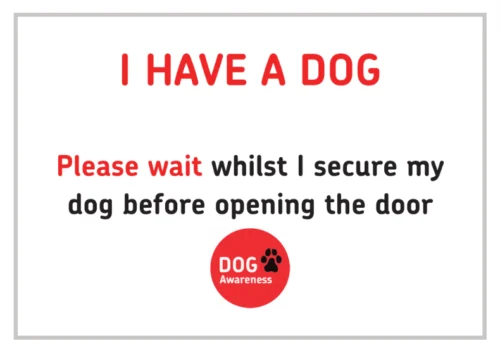
Official Royal Mail dog awareness warning sign displaying the four-word message and instructions for delivery workers.
Why Is Royal Mail Asking Dog Owners to Display Warning Signs in 2026?
Royal Mail’s campaign reflects the continuing safety risks faced by employees delivering letters and parcels.
On 6 July 2026, the company published updated figures showing that reported dog attacks had decreased from 2,197 in 2024/25 to 2,019 in 2025/26.
Despite this improvement, the number remains significant.
| Royal Mail dog attack statistics | 2025/26 |
| Total reported dog attacks | 2,019 |
| Average weekly attacks | 38 |
| Change compared with 2024/25 | Down 8% |
| Attacks at the front door | 1,048 |
| Attacks in gardens, drives or yards | 511 |
| Letterbox-related injuries | 324 |
| Serious or significant injuries | 61 |
| Working days lost | 3,442 |
One particularly concerning finding is that 52% of attacks occurred at the front door.
This demonstrates why securing dogs before opening the entrance is important.
Lizz Lloyd, Royal Mail’s Health and Safety Director, acknowledged the improvement while emphasising that:
“Every attack is one too many.”
The company’s wider message is that simple precautions can reduce exposure to avoidable hazards.
From a workplace safety perspective, warning signs operate as an early communication measure. However, physical barriers and controlled access remain essential because signage cannot physically prevent an attack.
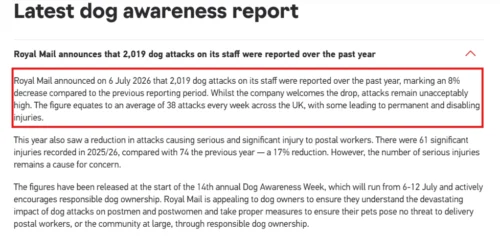
Royal Mail’s 2025/26 dog attack statistics, including the 2,019 reported incidents and the 8% annual reduction.
Is the Royal Mail Dog Warning Sign Compulsory for UK Households?
No. There is no general legal requirement for every UK dog owner to display Royal Mail’s particular warning sign.
It is a recommended safety precaution rather than a mandatory household notice.
Nevertheless, dog owners have legal responsibilities to prevent their animals from becoming dangerously out of control.
In England and Wales, dangerous dog legislation applies to incidents occurring on both public and private property, including the owner’s home.
Therefore, displaying a warning sign does not remove the owner’s responsibility if their dog injures somebody.
The distinction is important:
- A warning sign informs delivery workers that a dog is present.
- Proper supervision prevents the animal from approaching visitors.
- Secure gates and internal barriers reduce opportunities for escape.
- Legal responsibility can arise when a dog becomes dangerously out of control.
The official GOV.UK guidance on controlling dogs explains the circumstances in which owners may face prosecution.
The applicable legislation and enforcement arrangements can differ across the UK’s nations.
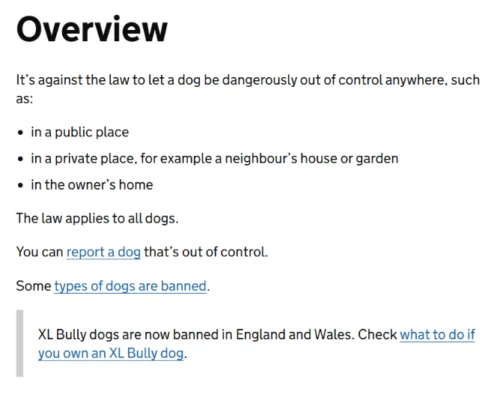
Government guidance confirming that dangerous dog laws can apply on private property, including a person’s home.
Where Can You Download the Royal Mail Dog Warning Sign for Free?
Royal Mail provides printable dog awareness cards in English and Welsh.
Owners can obtain the notice directly without purchasing a commercial warning sign.
To download it:
- Visit Royal Mail’s official Dog Awareness webpage.
- Find the section titled “GOT A DOG AT HOME?”
- Select the English or Welsh warning card.
- Open the downloadable PDF.
- Print the notice and position it where delivery workers can see it.
Households without access to a printer can create a clearly worded notice themselves.
However, using the official version provides a straightforward message specifically designed for doorstep deliveries.
For outdoor use, consider protecting printed notices from rain and damage so the information remains readable.
Businesses receiving deliveries at premises where dogs are present can adopt the same precautions.
Where Should You Display the Royal Mail Dog Warning Sign?
The effectiveness of a warning notice depends largely on its position.
A delivery worker should ideally see the message before reaching the point where an animal could approach.
| Sign location | Main advantage | Recommended situation |
| Front door | Clearly visible before answering | Most residential properties |
| Front window | Can be seen from the approach | Houses with windows facing the entrance |
| Front gate | Provides advance warning | Properties with enclosed gardens |
| Near the letterbox | Alerts workers to possible dog access | Homes with reactive dogs |
| Business entrance | Warns visiting delivery drivers | Pet-friendly workplaces |
A sign hidden behind furniture or obscured by decorations is unlikely to provide effective warning.
Properties with separate delivery entrances may benefit from displaying more than one notice.
However, placing a sign directly on a gate does not make it safe to leave a dog loose behind that gate.
A secure barrier remains necessary.
Why Are Dog Attacks on Postal Workers Still a Serious Concern?
Dog behaviour can change when unfamiliar people approach a property.
Even animals that normally behave calmly around family members may react defensively to delivery workers.
Common triggers include doorbells, unfamiliar footsteps, sudden movements and letters being pushed through the letterbox.
Royal Mail’s 2025/26 findings illustrate the main locations where incidents occurred.
| Attack location | Reported incidents | Share |
| Front door | 1,048 | 52% |
| Garden, drive or yard | 511 | 25% |
| Letterbox | 324 | 16% |
| Street or road | 135 | 7% |
The figures demonstrate that most incidents happen at or around residential delivery points.
Why Are Letterbox Attacks Particularly Dangerous?
Letterbox injuries occur when dogs reach a postal worker’s fingers while mail is being delivered.
Such incidents can happen even when the homeowner is not present.
Royal Mail recommends installing a letter cage or using an external delivery point to reduce contact between dogs and postal workers.
For properties where dogs regularly jump towards incoming letters, a secure internal letterbox cage is a practical improvement.
It also helps prevent animals from damaging delivered correspondence.
Can Royal Mail Suspend Deliveries Because of Your Dog?
Yes. Royal Mail states that deliveries may be suspended where a safe delivery point is not provided.
This is an important distinction from the voluntary warning sign.
Royal Mail does not generally suspend deliveries simply because a household has failed to display the sign. The underlying concern is whether postal workers can safely approach and deliver to the property.
A suspension may become necessary following an attack or when an unresolved dog-related hazard prevents safe access.
Customers affected by delivery restrictions should contact Royal Mail to clarify the situation.
Depending on the circumstances, alternative collection or delivery arrangements may be considered.
Homeowners may need to demonstrate that suitable precautions have been introduced before normal service can resume.
For example, securing an internal doorway, restricting access to the front garden or installing an external letterbox may help address the identified hazard.
Customers expecting parcels can monitor their consignments using Royal Mail tracking while resolving delivery problems.
However, a tracking update does not override a safety restriction affecting the delivery address.
What Should Dog Owners Do Before Opening the Door to a Postie?
The most reliable approach is to create separation between the dog and the delivery worker.
Homeowners should secure their animals before opening the entrance rather than attempting to restrain them while accepting a parcel.
Practical measures include:
- Moving the dog into a separate room.
- Closing the internal door securely.
- Keeping side gates locked or properly latched.
- Preventing access between rear gardens and delivery entrances.
- Installing a suitable letterbox cage.
- Using an external mailbox where appropriate.
- Ensuring children do not open the front door while a dog is loose.
For highly reactive animals, professional behavioural support may also be appropriate.
Professor Carri Westgarth, Chair in Human-Animal Interaction at the University of Liverpool, provides dog safety guidance featured on Royal Mail’s Dog Awareness page.
The broader safety principle is that owners should anticipate potential reactions rather than rely entirely on their pet’s previous behaviour.
This is particularly important when unfamiliar couriers visit the property.
Which UK Areas Recorded the Most Dog Attacks on Royal Mail Workers?
Royal Mail’s 2025/26 figures identify Sheffield as the postcode area with the highest reported number of attacks.
However, incidents are distributed across numerous regions.
| Postcode area | Location | Reported attacks in 2025/26 |
| S | Sheffield | 61 |
| DN | Doncaster | 53 |
| GU | Guildford | 53 |
| NE | Newcastle | 50 |
| PO | Portsmouth | 50 |
| NG | Nottingham | 48 |
| SA | Swansea | 44 |
| BT | Belfast | 37 |
| ME | Medway | 36 |
| TN | Tonbridge area | 35 |
| YO | York | 35 |
Sheffield recorded eight per cent fewer attacks than the previous reporting year but remained the highest-risk postcode area by total incidents.
Swansea experienced a particularly notable increase, rising from 25 to 44 incidents.
These statistics highlight the importance of preventive measures across both residential and commercial environments.
They should not, however, be interpreted as indicating that individual dogs in particular postcode areas are inherently more aggressive.
What Are the Legal Consequences if a Dog Attacks a Postal Worker?
In England and Wales, allowing a dog to become dangerously out of control can lead to criminal penalties.
Where a dog injures somebody, the potential consequences can be substantially more serious.
Under the applicable legislation, an aggravated offence involving injury to a person can result in imprisonment of up to five years, a fine or both.
Courts may also impose restrictions on dog ownership or make orders concerning the animal.
A warning sign is not an automatic defence against prosecution.
Importantly, Royal Mail has highlighted legal decisions concerning injuries sustained by postal workers posting letters through letterboxes.
These decisions demonstrate why property owners should not assume that an incident inside their own home necessarily falls outside dangerous dog legislation.
The safest approach is prevention through effective control and secure access arrangements.
How Can Businesses Reduce Dog-Related Delivery Risks?
The issue is not limited to private homes.
Small businesses, farms, workshops and other commercial premises may have dogs on site while receiving deliveries.
Where an animal can access the entrance, employers and occupiers should consider appropriate controls.
For example, a workshop with a resident guard dog should establish a secure delivery point that workers can use without entering the animal’s enclosure.
Pet-friendly offices should likewise ensure dogs cannot rush towards couriers arriving with parcels.
These measures support both workplace safety and reliable goods delivery.
Delivery disruption can also affect customer expectations, especially where a business relies on time-sensitive correspondence.
For businesses dealing with broader postal reliability concerns, the discussion around Royal Mail’s delivery performance provides additional context about the importance of dependable postal operations.
However, operational delivery targets and restrictions caused by unsafe access are separate issues.
Why Does the Warning Sign Matter Before Christmas 2026?
Christmas is traditionally an important period for online shopping and parcel delivery.
Households may receive more visitors carrying parcels, gifts and seasonal purchases.
Increased doorstep activity can create additional situations where dogs encounter unfamiliar delivery workers.
Displaying a warning notice before the festive period gives homeowners an opportunity to establish safer routines.
Nevertheless, the sign should be regarded as a year-round precaution rather than a temporary Christmas requirement.
A consistent delivery routine can help reduce risks whenever letters or parcels arrive.
If a parcel appears delayed, households can check what Royal Mail’s “in transit” tracking status means before assuming that an attempted delivery has taken place.
Conclusion
The Royal Mail dog warning sign is a free, voluntary safety measure intended to protect postal workers and household pets.
The official four-word message, “I HAVE A DOG”, asks delivery workers to wait while owners secure their animals.
With 2,019 reported attacks during 2025/26, Royal Mail’s latest statistics show why doorstep safety remains important despite the annual reduction.
Displaying a warning sign is useful, but it cannot replace proper supervision, secure gates, protected letterboxes and responsible dog ownership.
Taking these precautions can reduce the risk of injury and help avoid disruption to postal deliveries.
Frequently Asked Questions
Is the Royal Mail dog warning sign mandatory?
No. Royal Mail recommends displaying the warning notice, but there is no general legal requirement for UK dog owners to use this particular sign.
Can I download the Royal Mail dog warning sign for free?
Yes. Royal Mail provides printable English and Welsh versions through its official Dog Awareness webpage.
Can Royal Mail refuse to deliver because I have a dog?
Royal Mail can suspend deliveries where it cannot access a safe delivery point. Simply owning a dog does not automatically mean deliveries will stop.
Does the warning apply to small dogs?
Yes. Royal Mail’s safety advice concerns dogs of all sizes because even smaller animals can cause injuries at doors and letterboxes.
Can I create my own dog warning notice?
Yes. A clearly visible homemade notice can alert delivery workers, although Royal Mail’s official printable card is a convenient option.
What should I do if my dog bites a postman?
Secure the dog immediately, seek appropriate help for the injured person and cooperate with any investigation. Contact Royal Mail to discuss necessary safety arrangements before further deliveries.
Does displaying a warning sign protect owners from legal action?
No. A warning sign does not remove legal responsibility for controlling a dog or prevent prosecution where the relevant legal requirements are met.