Last reviewed: 6 October 2026
Tracking a Royal Mail parcel should usually be as simple as entering the reference number into the official tracker.
In practice, however, people often run into unfamiliar status messages, missing scans, apparently incorrect delivery locations or tracking numbers that do not seem to work.
Royal Mail tracking also varies according to the service used. Royal Mail Tracked 24, Tracked 48 and Special Delivery provide much more detailed tracking than services such as Signed For.
This guide explains how to track Royal Mail parcels, where to find your tracking number, what the different statuses mean, how long to wait between scans and what to do if a parcel appears stuck or has been marked as delivered when you cannot find it.
It also covers Parcelforce tracking, international parcels, compensation deadlines and how small businesses can use tracking more effectively.
How Do You Track a Royal Mail Parcel?
The safest way to track a parcel is through the official Royal Mail Track & Trace service.
To check an item:
- Find the tracking or reference number supplied by the sender.
- Enter the number exactly as shown, although spaces can normally be removed.
- Check the latest scan, its date and its location.
- Look at previous events to understand how the parcel has moved through the network.
- If a delivery option is available, Royal Mail may let you choose another delivery date, Safeplace, neighbour or collection point depending on the service and parcel.
A status such as “Sender preparing item” is different from an actual Royal Mail acceptance scan. It normally means shipment information has been created electronically but Royal Mail may not yet have physically processed the parcel.
If the parcel has stopped progressing altogether, our separate explanation of Royal Mail tracking not working covers the most common technical and scanning problems in more detail.
What Does a Royal Mail Tracking Number Look Like?
There is no single character count that should be used to identify every Royal Mail or Parcelforce parcel.
One common international postal format is the 13-character S10 reference. Royal Mail has previously illustrated this as two letters, nine digits and another two letters, for example:
ZW924750388GB
Parcelforce currently says its parcel references may contain 9, 11, 13, 14, 16 or 21 characters, so the old idea that every Royal Mail-related number must fall within a broad “9–27 character” range is not a useful validation rule.
| Service or reference type | Common appearance | What to know |
| Royal Mail S10-style reference | 13 characters, commonly two letters + nine digits + two letters | A UK-issued S10 number commonly ends in GB |
| Royal Mail Signed For | Often a 13-character postal reference ending GB | Signed For provides delivery confirmation rather than the same scan depth as Tracked services |
| Special Delivery Guaranteed | Commonly a 13-character reference; many references begin with an S-series prefix | Do not identify the service from the first letter alone; check the postage label or booking |
| International Tracked | Usually a 13-character S10-format reference | Prefixes can vary; examples may begin with letter combinations such as L- or R-series codes |
| Parcelforce / integrated Royal Mail network | 9, 11, 13, 14, 16 or 21 characters | References may contain letters and numbers |
| Other electronically generated references | Format can differ | Use the carrier and service shown on the dispatch confirmation rather than relying on length alone |
A reference such as 050111C31F4, for example, does not resemble the familiar two-letter/nine-digit/two-letter format but can still be a valid parcel reference depending on the service.
What Do the Letters in an S10 Tracking Number Mean?
The Universal Postal Union’s S10 standard is more informative than it first appears.
A standard S10 identifier contains:
- A two-letter service indicator.
- Eight serial-number digits plus a check digit.
- A final two-letter ISO country code assigned to the postal administration issuing the identifier.
For example, the UPU allocates ranges including LA–LZ for tracked letter-post items, RA–RZ for registered items and VA–VZ for insured items.
There is an important qualification. A number ending GB indicates that the identifier was issued under the authority of the UK postal administration.
The UPU specifically warns that the final country code should not always be treated as proof of the item’s physical country of origin, because postal operators can operate extraterritorial offices of exchange.
So the country suffix is useful for identifying the issuing postal system, but it should not be used as definitive evidence of where the seller actually posted the item.
Where Can You Find Your Royal Mail Tracking Number?
Check:
- The Post Office receipt or proof-of-posting certificate.
- The detachable part of a postage label.
- A Royal Mail Click & Drop confirmation.
- A retailer’s dispatch email.
- An online marketplace order page.
- An SMS or email sent for an eligible tracked delivery.
- A Parcel Postbox or parcel-locker booking/confirmation where the service generated one.
- A red “Something for you” card where Royal Mail has printed or written the relevant reference.
Businesses using Royal Mail Click & Drop should retain the tracking reference against the corresponding order rather than relying on the customer to preserve it.
What If You Lose the Receipt or Tracking Number?
This can be a serious problem.
Parcelforce says that if you lose your receipt or the tear-off portion containing the parcel number, it cannot retrieve the reference simply from your name and address.
Before assuming it is lost permanently, check your:
- Email inbox and spam folder.
- SMS messages.
- Marketplace account.
- Retailer account.
- Click & Drop history, if you sent the parcel.
- Photos of the parcel or label.
For a business sender, keeping the tracking reference digitally against the order is particularly important for customer disputes and compensation claims.
Can You Track Royal Mail by Name, Address or Postcode?
No. Royal Mail does not offer a public tracking search where someone can enter their name, home address or postcode and see parcels associated with them.
You normally need the tracking/reference number.
This is partly a security and privacy safeguard. If anyone could search an address and see every parcel travelling there, it would expose delivery information to people who were not involved in the transaction.
If you are the recipient and the reference is missing, contact the sender, retailer or marketplace seller first. They are normally the party that purchased the postage and should have the booking information.
Which Royal Mail Services Can Be Tracked?
Tracking depth depends heavily on the postage service.
| Royal Mail service | Tracking level | Typical delivery aim |
| Tracked 24 | End-to-end tracking with delivery evidence | Next working day |
| Tracked 48 | End-to-end tracking with delivery evidence | 2–3 working days |
| Special Delivery Guaranteed by 1pm | Full tracking, signature and delivery evidence | Guaranteed by 1pm next working day, subject to terms |
| International Tracked | Tracking through the UK and participating overseas networks | Commonly 3–5 working days Europe and 5–7 worldwide |
| Signed For | Limited journey visibility with delivery confirmation/signature | Based on the underlying First or Second Class service |
| Standard First/Second Class | Generally not end-to-end tracked | Service-dependent |
Royal Mail’s current consumer pages describe Tracked 24 and Tracked 48 as including tracking and delivery confirmation, while Special Delivery includes detailed tracking and a signature.
How Long Should Royal Mail Tracking Take to Update?
A tracking page is not a live GPS feed. It changes when the parcel reaches points in the network where another event or barcode scan is recorded.
That means a gap between updates does not automatically mean the parcel has been lost.
| Situation | What you may see |
| Label created but parcel not yet accepted | “Sender preparing item”, “Pre-advice received” or similar |
| Parcel placed in a postbox or parcel drop point | First physical scan may not appear until collection or processing |
| Item posted late on Saturday | The next meaningful movement may not appear until Monday or the next applicable working day |
| Travelling between mail centres | A gap of roughly 12–48 hours can occur without an intermediate public scan |
| Weekend or Bank Holiday | Fewer visible movements may appear depending on service and network operation |
| International hand-over | A temporary gap can occur between Royal Mail export and the overseas partner’s first scan |
The 12–48-hour range is a practical troubleshooting guide, not a Royal Mail service guarantee. Third-party tracking observations show such gaps can occur between sorting centres, but the real test is whether the parcel has passed the delivery aim and Royal Mail’s relevant loss threshold.
For Tracked 24 and Tracked 48, Royal Mail changed its claims rules from August 2025 so claims are not eligible until at least seven working days after the due delivery date.
What Do Royal Mail Tracking Statuses Mean?
Tracking terminology can look more complicated than the actual journey.
| Tracking status | What it normally means |
| Sender preparing item | Postage information has been created, but Royal Mail may not yet have physically received or scanned the parcel |
| Pre-advice received | Electronic shipment details have reached the carrier before, or separately from, the physical item |
| Accepted at Post Office | The item has been handed over and accepted at a Post Office |
| Accepted at Outward Mail Centre | It has entered the originating mail-centre network for sorting and onward transport |
| Item received | Royal Mail has recorded the parcel at a facility |
| In transit | The parcel is moving between processing points |
| Item leaving the UK | An international item has been processed for export |
| Item has left the overseas International Processing Centre | The parcel has progressed through an overseas processing stage |
| Due to be delivered today / Out for delivery | The parcel has reached the final delivery operation and is scheduled for a delivery round |
| Delivery attempted | A delivery was attempted but could not be completed |
| Delivered to Safeplace | The item was recorded as left in an approved or selected Safeplace |
| Delivered to neighbour | Royal Mail recorded delivery to an eligible neighbour |
| Delivered to household | The scan indicates someone at the delivery address accepted it |
| Delivered | Royal Mail has recorded the delivery event; photo, GPS map or signature may also be available depending on service |
| Item not delivered, customer service contacted | A delivery issue has been escalated or a customer-service interaction is attached to the item |
| Ready for collection | The parcel is being held at an appropriate collection location |
| Retention period ending | The item has not been collected and may soon be returned to sender |
“Out for delivery” frequently appears during the early part of the morning as delivery rounds are prepared, sometimes around 5am–9am, but Royal Mail does not guarantee that every parcel will receive that status within a fixed clock-time window.
Standard items held at a Customer Service Point are normally retained for 18 calendar days, although items involving customs charges can have different retention rules.
You can also read our explanation of what “in transit” means on Royal Mail tracking if that particular status appears to be stuck.
What Do MC, RDC, PDO and Other Royal Mail Tracking Terms Mean?
Some tracking feeds expose internal or semi-internal logistics language.
| Term | Practical meaning |
| MC | Mail Centre – a large processing/sorting facility |
| RDC | Regional Distribution Centre – a regional hub handling movements between parts of the network |
| PDO / Delivery Office reference | Generally relates to the local postal/delivery operation handling the final stage |
| Accepted at Outward Mail Centre | The parcel has entered the mail centre serving the originating side of its journey |
| Pre-advice received | Shipment data exists electronically, but this is not necessarily proof that the physical parcel has been processed |
| Early to late shift handover | An internal processing handover from one operational shift to another |
| Night to early shift handover | The parcel remains within processing while responsibility moves between shifts |
| Suspected dangerous goods | The parcel has been flagged for a safety/restricted-goods check and may be held, returned or handled differently |
| MDN | An internal/legacy routing marker that can appear in some tracking feeds; Royal Mail does not publish a sufficiently clear consumer definition to justify guessing at the acronym |
That last point matters. Some third-party tracking websites display hundreds of operational statuses without explaining them.
If Royal Mail has not defined an acronym publicly, it is safer to look at the facility name, timestamp and next event than to assign an unsupported expansion to it.
Why Has My Royal Mail Tracking Not Updated?
The most common reasons are:
- Royal Mail has shipment data but has not yet processed the physical parcel.
- The parcel was dropped somewhere that does not create an immediate acceptance scan.
- It is travelling between sorting facilities.
- The next facility has not yet scanned it.
- A weekend or Bank Holiday has interrupted the normal sequence.
- An international partner has not yet imported the Royal Mail data.
- A barcode is damaged or difficult to scan.
- The parcel has been missorted or delayed.
- There is a technical delay between an operational scan and its appearance on the customer-facing tracker.
Do not automatically start a claim because the page has been unchanged for 12 or 24 hours. Compare the elapsed time against the service’s expected delivery aim and the applicable loss threshold.
Why Does My Royal Mail Tracking Show the Wrong Location?
An unfamiliar mail centre is not necessarily evidence that your parcel is going to the wrong address. Royal Mail routes parcels through a national network, so an item can move away from what appears to be the most direct geographical route before returning towards the delivery area.
However, tracking can also show exceptions such as:
- Wrongly directed – the item has entered the wrong processing stream and needs rerouting.
- Address incomplete – part of the delivery address cannot be interpreted reliably.
- Addressee has a PO Box – different handling may be needed.
- Office closed – delivery could not be completed because the receiving premises were shut.
- Unable to access address – the delivery route could not safely or practically reach the property.
If the next scan moves the parcel back towards your local delivery operation, the network is usually correcting the problem itself.
What Should You Do If Tracking Says “Delivery Attempted” but You Were Home?
First, do not assume the driver or postie definitely reached your door at the exact moment the tracking event appeared.
Check the following:
- Look around the entrance, letterbox and immediate outside area for a “Something for you” card. Cards can occasionally be displaced by weather.
- Check tracking again to see whether the parcel has gone to a delivery office, Post Office, collection point or other location.
- Ask other people in the property whether they heard or answered the door.
- Check any Safeplace or neighbour information.
- If collection is available, follow the tracker’s instructions and take the required identification.
- If the information does not make sense, contact Royal Mail.
Royal Mail also offers redelivery and collection options for eligible parcels. Our explanation of how long Royal Mail keeps parcels before returning them is useful if you cannot collect immediately.
What Should You Do If Royal Mail Says Delivered but the Parcel Is Missing?
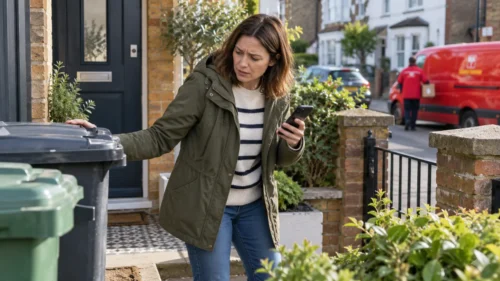
Start by opening the detailed tracking result rather than relying only on the word “Delivered”.
For eligible services, Royal Mail may provide:
- A delivery photograph.
- A GPS-confirmed delivery map.
- A signature.
- Safeplace information.
- Neighbour information.
- A timestamp.
Royal Mail explains that GPS-confirmed delivery can be displayed on a street map for qualifying items, although mapping information may not always be available for operational or privacy reasons.
Then check:
- Behind bins, gates and other appropriate Safeplaces.
- With everyone at the property.
- Immediate neighbours.
- A building reception or concierge.
- A communal post area.
- A workplace postroom if it was sent to work.
There is one useful exception to the usual urgency. Royal Mail’s own missing-delivery advice says that if an item was only scanned as delivered today, an occasional scanning error is possible and it advises allowing an extra day.
That advice is therefore legitimate, but it should not be interpreted as a reason to wait indefinitely.
If the delivery map or photograph looks wrong, Royal Mail Customer Services can be contacted on 03457 740 740. Ask them to check the delivery-scan or location evidence available for that item. Royal Mail lists the same customer-service number in its support material.
How Do Royal Mail SMS and Email Tracking Alerts Work?
The sender normally has to provide the recipient’s email address or mobile number when purchasing or preparing an eligible service.
Royal Mail’s business terms specifically provide for recipient email/SMS details to be included in pre-advice data for notification services.
Depending on the product and booking channel, notifications can include:
- Expected delivery information.
- Tracking updates.
- Delivery-day information.
- Delivery-option links.
- Attempted-delivery information.
- Collection information.
Royal Mail states that SMS/email notifications for retail Tracked products are available when those products are bought online.
This also means the absence of an SMS does not necessarily mean the parcel has not moved. The sender may simply not have supplied your contact information.
Can Parcelforce Parcels Now Be Tracked Through Royal Mail?
Yes. This is an important change from treating Parcelforce as a completely separate carrier for tracking purposes.
Parcelforce now states that it operates across a single network with Royal Mail and directs customers to Royal Mail Track & Trace for parcel tracking.
Parcelforce also says its references may contain 9, 11, 13, 14, 16 or 21 characters.
Therefore, a parcel should not automatically be rejected as “not Royal Mail” simply because its reference does not resemble the traditional 13-character Royal Mail example.
This is also why an unsupported table claiming that DPD or Evri numbers are always “10–16 characters” is not useful here. Carrier identification should be based on the shipping confirmation and carrier data, not an unverified generic length rule.
How Do You Track Royal Mail International Parcels After They Leave the UK?
International tracking frequently involves two postal networks.
Royal Mail handles the UK stage. Once the item reaches the destination country, a local postal operator or delivery partner may perform the remaining journey.
Royal Mail maintains an official list of international delivery partners and advises that more detailed information may become available on the overseas partner’s own tracking site once the item has left the UK.
Partners can include organisations such as GLS or national postal operators, depending on the destination and service. Royal Mail describes its international operation as working with local partners including GLS and La Poste.
So if a Royal Mail international parcel appears to stop updating after export:
- Copy the same tracking number.
- Find the destination partner using Royal Mail’s partner directory.
- Enter the reference on that operator’s official website.
- Compare its scans with Royal Mail’s record.
Do not assume every European parcel follows the same GLS route. The delivery partner can vary by destination and product.
What Should You Do If a Royal Mail Parcel Appears Stuck?
A simple decision tree helps avoid contacting the wrong organisation too early.
NO TRACKING UPDATE
↓
Does tracking only say “Sender preparing item” or “Pre-advice received”?
→ Yes: Ask the sender whether the parcel has physically been handed over.
→ No: Continue below.
↓
Has it received at least one Royal Mail acceptance or processing scan?
→ No: Sender should check proof of posting or handover.
→ Yes: Continue below.
↓
Is the parcel still inside its normal delivery aim?
→ Yes: Continue monitoring. Gaps between network scans can occur.
→ No: Continue below.
↓
Has it reached Royal Mail’s loss-claim threshold?
→ No: Monitor it and check for disruption or an international hand-over.
→ Yes: The sender should investigate and, where eligible, submit a claim with the required evidence.
When Is a Royal Mail Parcel Considered Lost?
“Later than expected” and “lost for compensation purposes” are not necessarily the same thing.
For retail services, Royal Mail’s current compensation policy uses service-specific thresholds.
| Service | When a loss claim generally becomes eligible |
| First Class / Signed For First Class | 10 working days after the due delivery date |
| Second Class / Signed For Second Class | 10 working days after the due delivery date |
| Special Delivery Guaranteed by 1pm | 5 working days after the due delivery date |
| Tracked 24 / Tracked 48 | At least 7 working days after the due delivery date under the current terms |
| International services to Europe | Generally 20 working days after the due date for loss |
| International services outside Europe | Generally 25 working days after the due date for loss |
Always check the current product terms before making a claim because different contractual products and business accounts can have different rules.
What Are the Royal Mail Claim Deadlines?
This is another area where a single “80-day rule” can be misleading.
For many ordinary UK retail loss claims, Royal Mail requires the claim within 80 calendar days of posting.
However:
- Current Tracked 24/48 terms provide a more specific claim period linked to the date the claim becomes eligible, including a 30-calendar-day claim window under the revised terms.
- Tracked 24/48 damage or part-loss claims also have specific shorter requirements.
- International compensation claims can generally be made within six months of posting, subject to the applicable international service terms.
Do not leave a claim until the end of the longest possible period. Once the service’s eligibility threshold has passed and the item cannot be found, gather the evidence and act promptly.
What Evidence Should You Keep?
Royal Mail may require evidence including:
- A certificate or receipt showing proof of posting.
- A validated online-postage certificate where applicable.
- Confirmation of a Royal Mail collection.
- The tracking/reference number.
- Evidence of the item’s value.
- Purchase receipts.
- Invoices.
- Bank or card records.
- PayPal or other transaction evidence.
- Evidence of manufacturing cost where relevant.
- Repair costs or valuations in suitable cases.
Royal Mail’s retail compensation policy sets out the acceptable forms of evidence in more detail.
Our separate article on claiming compensation from Royal Mail explains the claims process more fully.
How Much Compensation Does Royal Mail Tracking Include?
Compensation needs to be quoted against the specific service and purchase channel, rather than using one figure for every tracked parcel.
As reviewed on 5 October 2026, the principal consumer service pages show:
| Service | Standard compensation shown by Royal Mail |
| First Class | Up to £20 |
| Second Class | Up to £20 |
| Signed For First Class | Up to £20 |
| Tracked 24 retail | Up to £75 |
| Tracked 48 retail | Up to £75 |
| Special Delivery Guaranteed by 1pm | Up to £750 as standard |
| Special Delivery Guaranteed by 1pm with enhanced cover | Options up to £1,000 or £2,500 |
| International Tracked | £50 standard, with an option to increase to £250 on eligible purchases |
Royal Mail’s current retail Tracked 24 and Tracked 48 pages state £75 compensation, not the £100 or £150 figures sometimes shown by third-party tracking websites.
Special Delivery Guaranteed by 1pm currently includes up to £750 as standard, with additional cover options available.
International Tracked currently shows £50 standard cover with the option to increase that to £250.
Business-account products are different. Royal Mail has published business material referring to higher inclusive compensation for some business Tracked arrangements, including up to £150 in relevant terms.
A business therefore should not use the consumer £75 figure automatically or assume that £150 applies to every parcel. Check the actual account contract and service used.
Who Should Contact Royal Mail First?
Who purchased the postage matters.
| Situation | Who should normally act first? | Why? |
| You bought something from a retailer | Retailer/sender | Your purchase contract is normally with the seller and the sender has the postage evidence |
| You sent the parcel yourself | You | You hold the postage contract, tracking number and proof |
| Marketplace buyer | Seller first, then marketplace support if needed | The seller normally purchased the postage; buyer-protection procedures may also apply |
| Marketplace seller | Royal Mail/booking provider | Seller should retain posting and delivery evidence |
| Recipient querying a suspicious delivery scan | Royal Mail can help with delivery evidence | Customer Services may be able to inspect the delivery event |
| Business sending customer orders | Business/sender | The business should manage the carrier investigation rather than sending every customer directly to Royal Mail |
For an online purchase, telling the buyer simply to “claim from Royal Mail” can therefore be the wrong first step.
How Should Small Businesses Use Royal Mail Tracking?
For an ecommerce business, tracking is not just a customer convenience. It is part of the order record.
A sensible workflow is:
- Create postage through Click & Drop or the business’s shipping system.
- Store the tracking number against the order automatically.
- Put a direct tracking link into the dispatch email.
- Pass the customer’s email/mobile details for eligible notifications where consent and the chosen system allow.
- Retain proof of posting.
- Retain delivery evidence such as a photograph, signature or GPS-confirmed map where provided.
- Keep records long enough to deal with returns, chargebacks, marketplace disputes and carrier claims.
- Make staff check tracking before answering “Where is my order?” enquiries.
Royal Mail’s business Tracked products can provide tracking for both the sender and recipient, delivery notifications and delivery evidence including photographs and GPS information on eligible items.
Businesses sending products regularly should also understand the practical steps involved in sending a parcel with Royal Mail, particularly around packaging and proof of posting.
How Can Tracking Reduce “Where Is My Order?” Queries?
Do not send a dispatch message that merely says “Your order has shipped.”
Include:
- The carrier.
- The tracking reference.
- A clickable tracking link.
- The service used where useful.
- The expected delivery window.
- A short explanation that tracking may take time to show its first physical scan.
That lets customers answer many routine delivery questions without contacting the business.
Tracking evidence can also be valuable when dealing with payment disputes. A business should preserve the evidence rather than assuming the carrier’s public tracking page will remain available forever.
How Can You Avoid Royal Mail Tracking Scams?
Delivery scams commonly exploit the fact that people are already waiting for parcels.
Be suspicious of a message that:
- Demands an unexpected small redelivery fee.
- Creates artificial urgency.
- Sends you to a strange domain.
- Requests excessive card or banking information.
- Claims your parcel will be permanently destroyed unless you pay immediately.
- Uses a reference that does not match any order you recognise.
Rather than following the link in an unexpected message, open Royal Mail’s website independently and enter the tracking number yourself.
For suspicious mobile messages, our explanation of Royal Mail parcel-notification text scams covers common warning signs. Email recipients can also check how to tell whether a Royal Mail email is genuine before opening links or supplying personal information.
What Is the Difference Between Redelivery, Redirection and Keepsafe?
These Royal Mail services solve different problems.
| Option | What it does | Typical use |
| Redelivery | Arranges another delivery of an item Royal Mail has already attempted to deliver | You missed a parcel |
| Redirection | Sends eligible future mail from an old address to another address | You are moving home or business premises |
| Keepsafe | Temporarily holds eligible mail while you are away | Holiday or temporary absence |
A redelivery therefore does not permanently redirect your post.
If you are moving, see our information on Royal Mail post redirection rather than repeatedly arranging redelivery.
Royal Mail also continues to expand alternative collection options, including Royal Mail parcel lockers in supported locations.
FAQs
Can I track Royal Mail without a tracking number?
Normally, no. Public Royal Mail tracking requires the relevant reference number. If you are the recipient, ask the sender or retailer to provide it.
Can Royal Mail track a parcel using my postcode?
A postcode can be used as part of some delivery-management or verification processes, but it does not replace the tracking number for publicly searching for a parcel.
Why does Royal Mail say “Sender preparing item” for several days?
The sender may have created the postage label without Royal Mail yet recording a physical acceptance scan. Ask the sender to confirm when and how the parcel was handed over.
Why has “In transit” not changed for 24 hours?
Parcels can travel between processing centres without a public scan at every stage. Compare the delay with the delivery aim rather than treating a 24-hour gap alone as proof of loss.
Can I track a Parcelforce parcel on Royal Mail?
Yes. Parcelforce says it now operates on a single network with Royal Mail and directs customers to Royal Mail Track & Trace for relevant parcel tracking.
Can Royal Mail show where my parcel was delivered?
Eligible tracked items can include a delivery photograph and GPS-confirmed map. If the information appears wrong, contact Royal Mail and ask them to investigate the delivery evidence.
Does a tracking number ending GB prove the parcel was posted in Britain?
Not absolutely. Under the UPU S10 system, GB identifies the postal administration that issued the identifier. The UPU warns that the suffix is not always definitive proof of the physical country of origin.
How long should I wait before claiming for a missing parcel?
It depends on the service. For example, current Tracked 24/48 rules generally require at least seven working days after the due delivery date before a loss claim becomes eligible. Other UK and international products use different thresholds.